
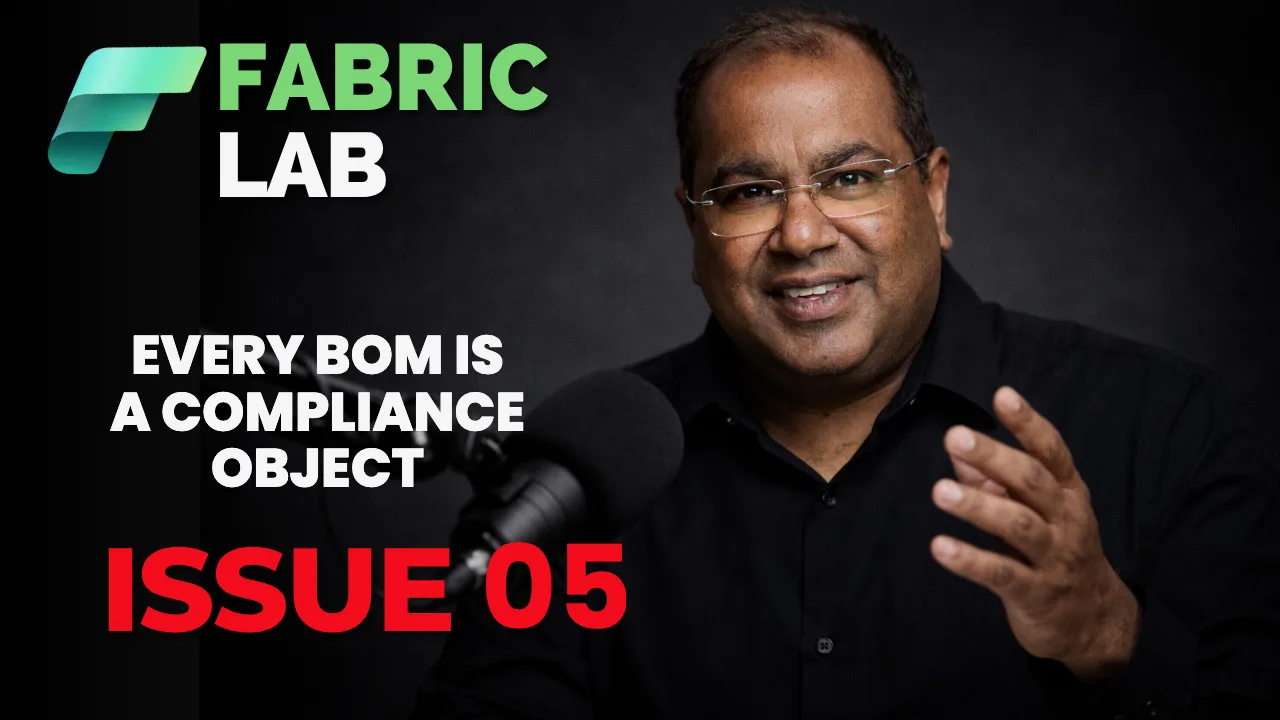
Section 232 and 301 turned every bill of materials into a compliance document. Most ERPs were never built to answer the question an auditor asks now.
Fabric Lab · Issue 05 · By Dave Goyal
A CFO called me last month. Her first words: the tariff broke our BOM data. She was not wrong. Her ERP tracks parts by SKU. It does not track parts by country of origin, tariff classification code, or supplier ship-from address. When Section 232 changed, her team could not answer the one question their auditor asked: which of your products are exposed. They spent three weeks in Excel finding out.
The Scale Of What Changed
Thomson Reuters processed more than 155 million changes to its tariff databases in 2025, a pace tracking even higher through 2026. 72% of trade professionals now rank U.S. tariff volatility as their top regulatory challenge, up from 41% just twelve months earlier.
Reshoring is adding urgency on top of that. Announced U.S. manufacturing investment ran to roughly $1.42 trillion between January 2025 and mid-March 2026, concentrated in semiconductors, pharmaceuticals, and advanced manufacturing. Every new plant coming online needs a data foundation built for this reality from day one, not retrofitted after the first audit.
The Six Questions Your Auditor Will Ask
Every American manufacturer with imported components should be able to answer these six, inside their ERP, without an Excel fire drill.
1. Which of your SKUs contain components sourced from Section 232 or 301 countries?
2. What is the country of origin for each component, down to the sub-assembly level?
3. What percentage of your COGS is tariff-exposed today versus twelve months ago?
4. Have you re-classified any products under HTSUS codes in the last six months?
5. Can you show a full audit trail of BOM changes tied to tariff decisions?
6. If a new tariff dropped today, how fast could you re-price your top ten customers?
If you cannot answer all six from your ERP right now, you have a data project. Not a compliance project, not a procurement project. A data project.
The Data Model, Not Just The Questions
The good news is Microsoft Fabric can hold this model, and it does not require exotic architecture. A tariff-ready foundation needs four things: component country of origin captured at the BOM level, HTSUS code mapping tied to each SKU, supplier ship-from address tracked separately from supplier legal address (they are often different), and automated re-classification triggered when codes change.
None of this replaces your ERP. It sits on top of it, in OneLake, joined to the BOM and supplier tables you already have. Most mid-market manufacturers can stand this up as a focused 12-week engagement, not a multi-year transformation.
What This Means For You
If you cannot answer all six questions today, that is normal, not a failure. Most mid-market manufacturers cannot. The gap is the opportunity to get ahead of your next audit instead of reacting to it.
If you are already reshoring or adding U.S. capacity, build the tariff data model into the new plant’s foundation now. Retrofitting it later costs more than building it in from day one.
If your board is asking about tariff exposure this quarter, the six questions above are a ready-made framework to bring to that conversation.
The One Ask
If you want your own BOM run against these six questions, I am opening a few slots this month for a Tariff Visibility Accelerator scoping call: no cost, one hour, a real answer on where your gaps are.
No pitch at the end. You keep the gap list whether or not we ever talk again.
Reply here or DM. Which of the six is hardest for your shop? Tell me in the comments.
I read every reply.
Sources
- Thomson Reuters Institute, “2026 Global Trade Report: Tariff turbulence is elevating strategic role of trade departments” (155 million tariff database changes in 2025; 72% of trade professionals rank tariff volatility as top challenge, up from 41%): https://www.thomsonreuters.com/en-us/posts/corporates/2026-global-trade-report/
- Reshoring investment tracking, announced U.S. manufacturing investment January 2025-March 2026 (~$1.42 trillion, concentrated in semiconductors, pharmaceuticals, advanced manufacturing): industry reshoring investment trackers, 2026.
Dave Goyal
Founder, Think AI Consulting Corporation
Host, The Think AI Podcast
New here? I write Data and AI Demystified, the hidden costs and reality checks on Microsoft Fabric most partners won’t publish. Subscribe here.
#Tariffs #SupplyChain #Manufacturing #MicrosoftFabric #DataStrategy
Click here to read this article on Dave’s Demystify Data and AI LinkedIn newsletter.